
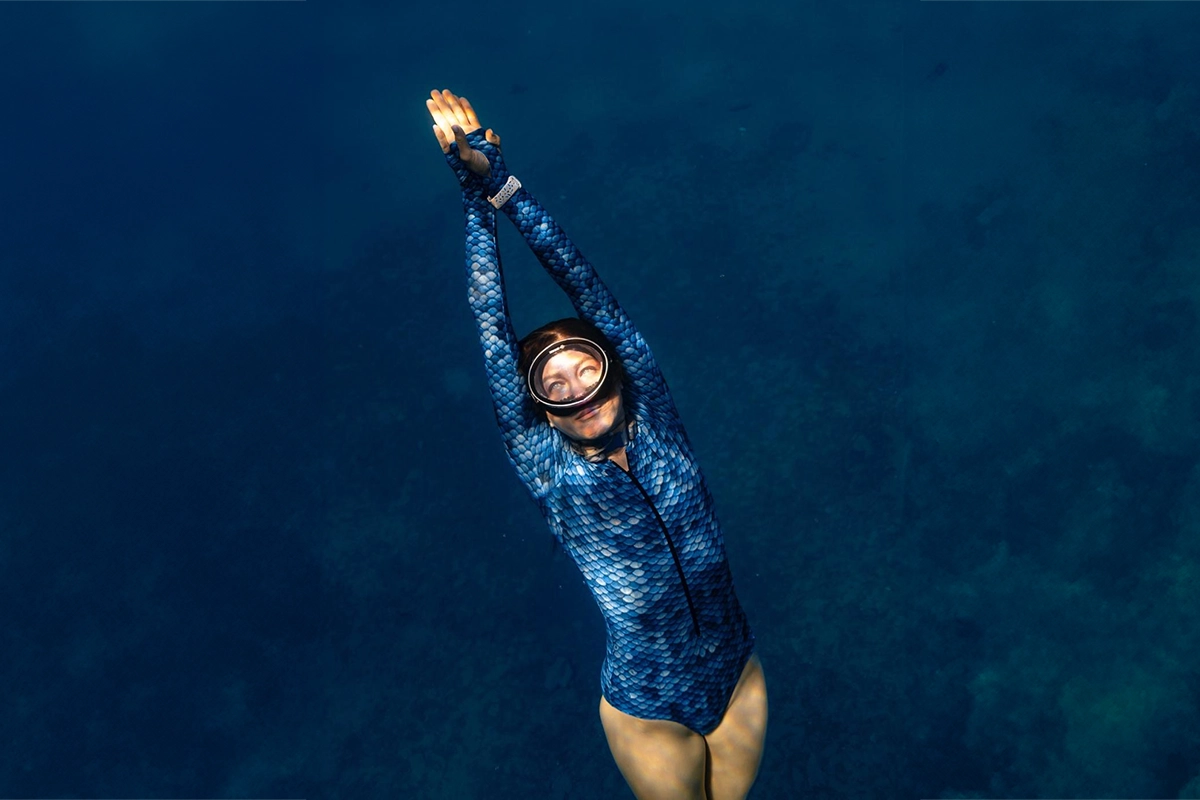
Turkish freediver Birgül Erken describes how the currents of Çanakkale, literature teaching and photography have shaped a career centred on attention, technical improvement and a legacy beyond competition.
Birgül Erken’s account of freediving reaches beyond competition. The Turkish athlete connects her experience underwater with literature, photography and teaching, describing a life in which physical discipline and close observation continually inform one another. Her reflections offer a portrait of achievement measured through learning as well as results.
A Formation in Çanakkale
Growing up around the strong and unpredictable currents of Çanakkale gave Erken an early experience of resistance. In her account, the lasting lesson was not to overpower the water but to understand it. That distinction shapes how she describes preparation and concentration.
Calmer competitive conditions do not mean becoming less attentive. She sees them as an opportunity for greater precision, carrying the memory of more difficult environments without turning that experience into unnecessary struggle. Her emphasis is on awareness, technique and the ability to manage her own reactions.
Reading Beneath the Surface
Erken’s work in Turkish language and literature offers a second way of thinking about depth. Reading a text and observing an underwater environment both demand patience and attention to what an immediate impression can conceal. She describes silence as a space of concentrated experience rather than an absence.
Teaching has also helped keep her grounded. Students saw sustained effort expressed through an activity beyond the classroom; she, in turn, credits them with keeping her curious. The relationship between teacher and athlete is reciprocal, with neither role treated as a complete identity on its own.
Photography as a Method of Learning
Her interest in photography has an artistic and a practical dimension. Images help her think about composition, light and movement, while recordings of training provide material for reviewing technique. Watching herself makes improvement more specific than relying on memory alone.
The wider lesson in Erken’s reflections is about disciplined self-observation. Progress involves noticing, assessing and adjusting rather than simply demanding more effort. Her account links international sporting achievement with education and creative work, placing lasting value in the example an athlete can offer to others. It is that combination of attention, curiosity and purpose that gives her story a reach beyond the competition itself.
Source: DipTalk. Adapted from the original interview published by Mosaic Digest. Image from the original Mosaic Digest feature.