
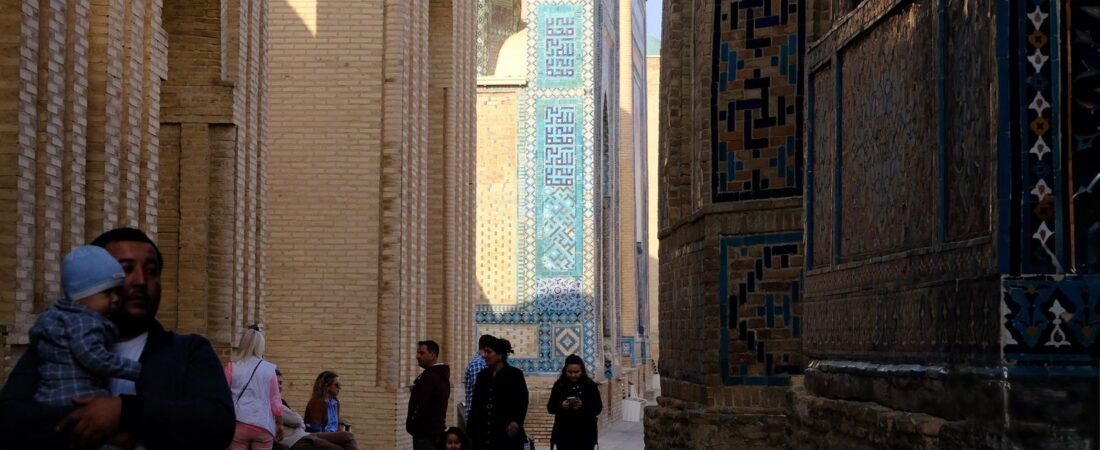
Samarkand, Bukhara and Khiva are often presented as a procession of monumental views. Their architecture deserves the attention, but a rewarding journey through Uzbekistan needs more than a rapid sequence of squares and façades. The spaces between major sights offer room to notice scale, craft and the ordinary use of a historic city.
Start by deciding how much ground the trip can reasonably cover. Three celebrated cities do not automatically make the best short holiday. A route with time to return to a neighbourhood can reveal more than one that allows only a single walk through each place.
Give Samarkand separate chapters
Uzbekistan’s official tourism material identifies the Registan, Shah-i-Zinda and Gur-e-Amir among Samarkand’s major landmarks. Each needs its own attention. A guide can help distinguish function, chronology and restoration rather than allowing the decoration to become a beautiful but undifferentiated sequence.
Visit religious and funerary spaces with care. Observe local signs and dress guidance, give worshippers and residents priority, and ask about photography rules. An attractive doorway should never be taken as permission to enter.
Look for the working city
The national architecture guide points towards Bukhara’s Po-i-Kalyan and Lyabi-Hauz, and Khiva’s architectural ensemble. Use those references to orient the visit, then leave time for a meal, a craft shop or a less hurried return to a public space. Avoid assuming that every object sold beside a monument was made locally; ask who produced it and where.
Food stops can break up a long day of looking. Ask about ingredients, portions and the final price before ordering, especially when a menu is unfamiliar. Water, shade and rest are practical parts of an architectural itinerary, not distractions from it.
Plan the links before the details
Official itineraries show how rail travel can form part of a journey between Uzbekistan’s major cities. They should be used as inspiration rather than a live timetable. Confirm current routes, departure stations and tickets separately, and allow time for transfers to accommodation. A late arrival is a poor moment to discover that a hotel has no reception arrangement.
Travelling slowly here does not mean refusing the great sights. It means giving them enough context to remain distinct in memory. A tiled monument, a maker’s explanation and a quiet hour in a city square can belong to the same story, if the itinerary leaves room for all three.
Plan your visit
- Uzbekistan Tourism: Samarkand
- Uzbekistan Tourism: architecture
- Uzbekistan Tourism: a rail-based city itinerary
Photo by Rüveyda Akkaya.